Freya Ludwig · 3 September 2026
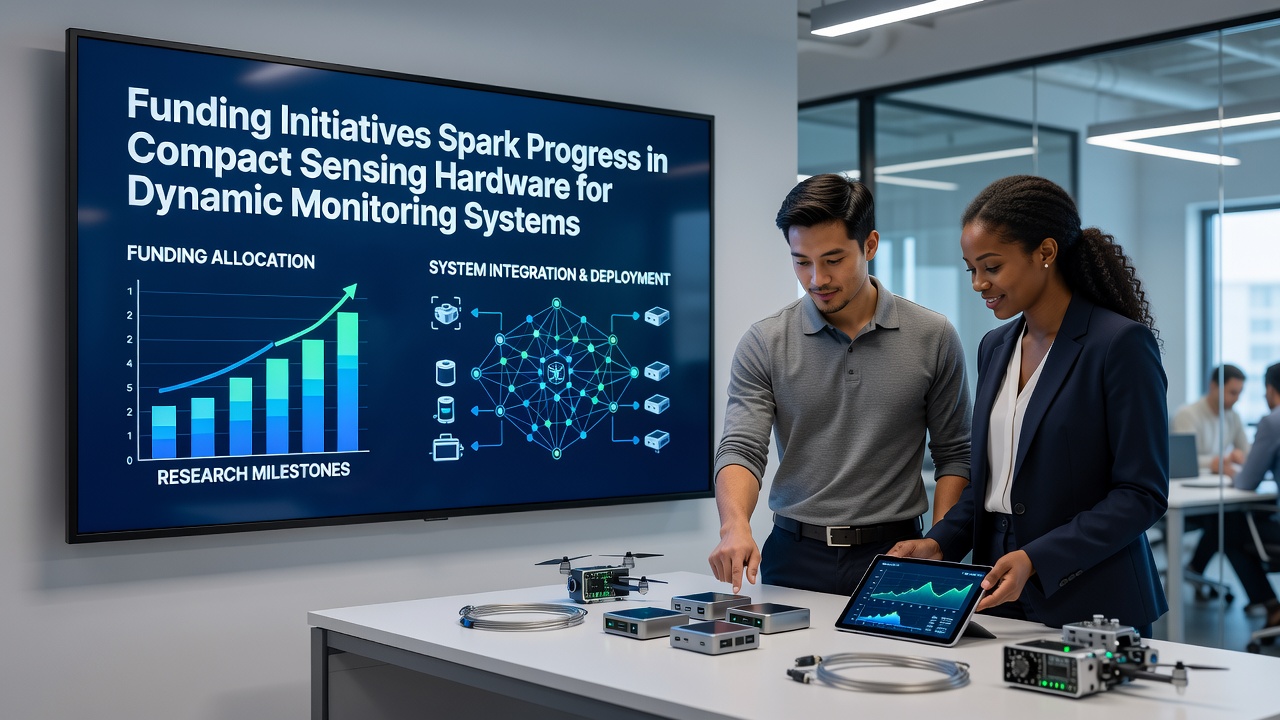
Funding Initiatives Spark Progress in Compact Sensing Hardware for Dynamic Monitoring Systems
Funding initiatives from government agencies and research foundations have accelerated development of compact sensing hardware designed for dynamic monitoring systems across multiple sectors, and these efforts focus on miniaturization, energy efficiency, and real-time data processing capabilities. Researchers at institutions worldwide have reported measurable gains in sensor performance since increased grant allocations began in prior years, with particular emphasis on devices that operate reliably in variable environments.
Core Technologies Driving Hardware Advances
Compact sensing hardware integrates microelectromechanical systems with advanced signal conditioning circuits, while dynamic monitoring systems require continuous data streams from sensors that track parameters such as vibration, pressure, temperature, and motion. Engineers have refined fabrication techniques that reduce device footprints without sacrificing accuracy, and recent prototypes demonstrate integration of multiple sensing modalities into single packages measuring just millimeters in scale. Data from laboratory tests indicate improvements in power consumption, which extends operational life in battery-dependent applications.
Key Funding Programs and Their Impact
Multiple organizations have directed resources toward these developments, including the National Science Foundation in the United States and the European Research Council, which prioritize projects that combine hardware innovation with practical deployment scenarios. Grants have supported collaborative efforts between academic groups and industry partners, resulting in shared testing facilities that validate sensor performance under controlled stress conditions. In September 2026 a joint initiative between Canadian and Australian research bodies released updated specifications for sensor interoperability standards, and these guidelines address compatibility across different monitoring platforms used in infrastructure and environmental tracking.
Additional support comes from industry consortia that pool resources for pre-competitive research, and this approach allows smaller teams to access specialized equipment for prototyping. Figures from recent award cycles show that funding levels for compact sensor projects rose by double-digit percentages compared with earlier periods, while project timelines shortened due to streamlined review processes at several agencies.

Applications in Real-World Monitoring
Dynamic monitoring systems benefit from these compact sensors in healthcare settings where wearable devices track physiological signals during patient movement, and similar technology supports structural health assessments on bridges and buildings exposed to changing loads. Industrial facilities employ the hardware for predictive maintenance on rotating machinery, where early detection of anomalies prevents unplanned downtime. Environmental researchers deploy networks of small sensors to monitor soil conditions and air quality in remote locations, and the reduced size enables placement in previously inaccessible areas.
One research team documented successful integration of compact sensors into drone-based inspection systems, and the resulting data streams provided higher resolution than previous bulkier alternatives. Observers note that these deployments often reveal unexpected performance characteristics once sensors operate outside controlled lab conditions, prompting iterative design adjustments funded through follow-on grants.
Technical Challenges Addressed Through Recent Work
Power management remains a central concern for compact hardware, yet new energy harvesting methods that capture ambient vibrations or thermal gradients have extended device autonomy in field tests. Signal interference in dense monitoring networks presents another hurdle, although shielding techniques and adaptive filtering algorithms developed under funded projects have improved data integrity. Researchers continue to refine calibration procedures that maintain accuracy across temperature swings and mechanical stress, and published test results confirm that newer sensor batches meet tighter tolerance specifications than earlier versions.
Supply chain considerations also influence progress, since specialized materials for sensor fabrication require reliable sourcing. Collaborative funding models have encouraged regional manufacturing partnerships that reduce lead times for prototype components, and these arrangements support faster iteration cycles during development phases.
Conclusion
Continued investment in compact sensing hardware supports ongoing refinement of dynamic monitoring systems, and outcomes from funded projects provide concrete benchmarks for future work. Organizations tracking these developments report steady expansion of application domains as device capabilities align more closely with operational requirements in diverse environments. The pattern of incremental hardware gains tied to targeted funding suggests sustained momentum through the remainder of the decade.